

MEDSKOS - the Braga, Portugal mobility
My diary
Neas and my first day at Centro Social de São Lázaro was full of incredible first impressions. A metalhead driver from Braga Mob drove us to the institution - even though the building was two minutes Th away from the hotel on foot. When we got there the head nurse Fatinha and a doctor, Katarina gave us a warm welcome, as well as all the information we needed. We were amazed because they spoke English. It wasn't perfect, but we understood them. The day after we met the nurse and the "big boss" Nuno, who wasn't our mentor on paper, but he decided that he was going to be our mentor. Our real mentor quit a few weeks before we arrived! :) Later we met his father, who is also a nurse at the institution. During the last day there, while chasing everyone and anyone for paperwork, they told us that Fatinha was Nuno's mum!
A family business! Nuno is an ER nurse in a hospital in Braga, as well as the manager of Centro Social de São Lázaro. He specializes in nursing and BLS, as well as rehabilitation. Same as his dad. Nuno did his best to explain the basics of nursing and physiotherapy to Nea and me. He gave us some tasks and tips. We watched him dress wounds, he showed me care plans and some other paperwork. We mostly just talked to him and exchanged information about healthcare systems in our countries. Through our conversations, I learned that nurses in Portugal are way more independent and respected than in Croatia. No one can tell them what to do.
Nurses and caretakers are two different, separated things at Centro Social de São Lázaro. This is why Nuno was openly very against me participating in the personal Hygiene of the residents. He insisted on me taking the vitals every morning. I did both things. Nuno tested my knowledge of dressing wounds, vital signs values, and nursing documentation. He might be relatively young, but he still had a lot of wisdom and knowledge to share. He asked Nea and me about our plans - if we wanted to stay in Croatia or not specifically. We both agreed that we wanted to move to the UK. He surprisingly supported us and told us that we definitely should work on accomplishing that. I felt motivated because people usually tell me I'm crazy when I tell them about our plans. Nuno mostly focused on the salary and conditions of nursing jobs in the UK. It was a privilege having him as a mentor.

During the first few days, Nea and I struggled to find anyone who would let us stick around with them. Until one day while running around trying to find anyone who spoke English, or at least anyone who didn't ignore our existence - I randomly asked a youngish blonde and short woman with cool necklaces if she spoke English. SHE SAID YES!! Then just mysteriously disappeared.
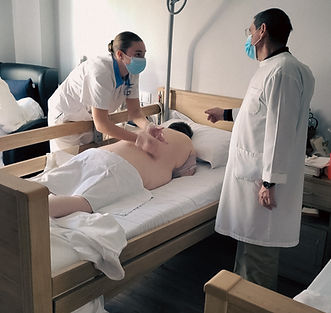
The day after we found her again. Her name is Paula, she's a caretaker. She agreed to be our unofficial mentor, show us around, let us work with her, and explain their work routines. She turned out to be an amazing teacher. She let me participate in personal hygiene, and bed making, showed me how they do the laundry, distribute meals and medicine, change patient's positions, measure blood glucose levels, and keep them under control.
We even went on an adventure to find socks without holes for her. She told us about her daughter who is learning English, so they speak English around the house and practice it together. I showed her how we do some things at our hospital and taught her some things as well! She always has a smile on her face and can light up any room while still staying responsible and professional. Paula is definitely the person that Nea and I are most thankful for. We wouldn't have learned anything if it wasn't for her. I'm glad we found her, and we wish her the best. Unfortunately, we don't have any selfies with her, but here are some photos...


Zita is the last caretaker that we met who spoke English. Her story is very interesting but sad at moments. She is from Africa and speaks many languages. Portuguese because of the colonies, that is her mother language. English and Danish because she worked in Denmark. She had to move to Braga because of her husband's job. She doesn't like it at Centro Social de São Lázaro. Mostly because she wasn't accepted very well by her other colleagues. As she says, they're always gossiping and she can't wait to move back to Denmark. She just needs to wait for all the papers she needs to do so. She always looked annoyed or sad under her smile which she always wore proudly right by the bright pink flower in her hair. Zita was sure that she had no friends at the institution until we convinced her that we would always stay her friends, even after we left.

All the other caretakers were never grumpy and always smiled even though they had lots of work to get done. They were often singing, dancing, and wearing earphones while walking the hallways. I noticed that physical touch is very important for them. It's a way of forming a connection between the residents and employees. Be it a pat on the head, or cheek, holding hands, or a simple hug. I found that very sweet and innocent. They were determined to speak in Portuguese with Nea and me, hoping that one day we would wake up fluent in it. We didn't mind.


